Louisiana Title Transfer Paperwork Checklist for Buyers and Sellers
Quick Answer: For most Louisiana vehicle title transfers, you need a completed DPSMV 1799, the current title signed correctly, a notarized bill of sale or equivalent sale documentation, a valid photo ID, and any extra paperwork tied to liens, odometer disclosure, or special cases like inherited or out-of-state vehicles.
Need help with a Louisiana title transfer?
Do not risk a delay over one missing signature, a title mistake, or sale paperwork that does not match. Title Authority helps drivers in Covington and across the Northshore handle Louisiana vehicle title transfers with less guesswork and fewer OMV headaches.
TLDR
- You usually need DPSMV 1799, the current title, sale paperwork, and ID.
- If the title is not filled out correctly, the transfer can stall fast.
- If a lien is involved, lien release or lien filing paperwork may apply.
- If plates are being issued, proof of insurance matters too.
- Lost title, inherited vehicle, and out-of-state cases need extra documents.
- Seller and buyer details must match across the title and sale paperwork.
- Title Authority in Covington can review the file before submission and help you avoid a wasted trip.
Louisiana title work gets messy for the same reason most OMV problems do. One missing signature, one lien that never got released, or one price mismatch between the title and the bill of sale can slow down the whole file.
For people in Covington, St. Tammany Parish, and across the Northshore, the real goal is simple: show up with the right paperwork the first time and move the transfer forward without guessing.
Need help now? If you are sorting out a private sale, an inherited vehicle, an out-of-state transfer, or a missing title issue, schedule an appointment with the Title Authority or call the Covington office before you come in.
Start With the Standard Louisiana Title Transfer Checklist
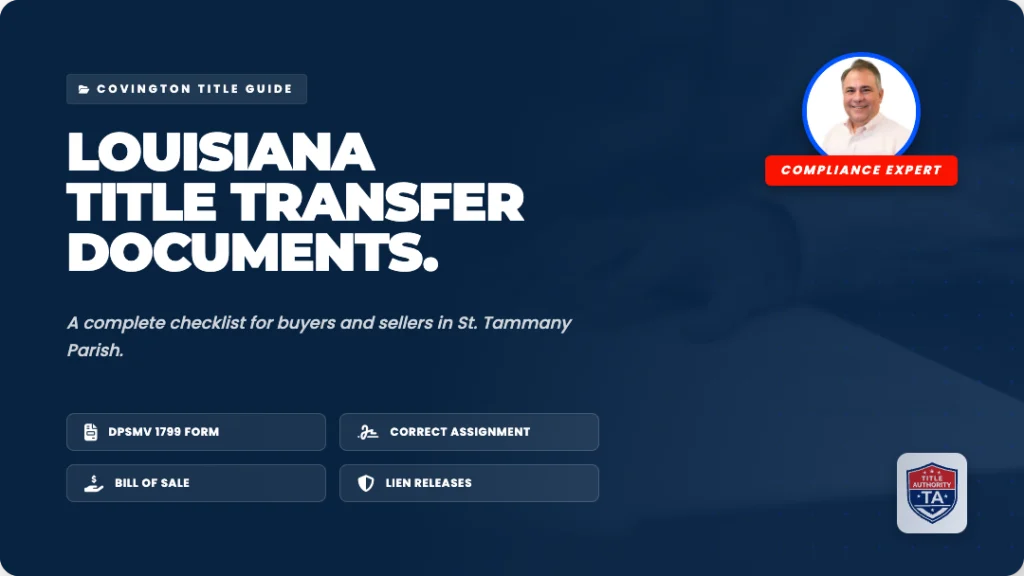
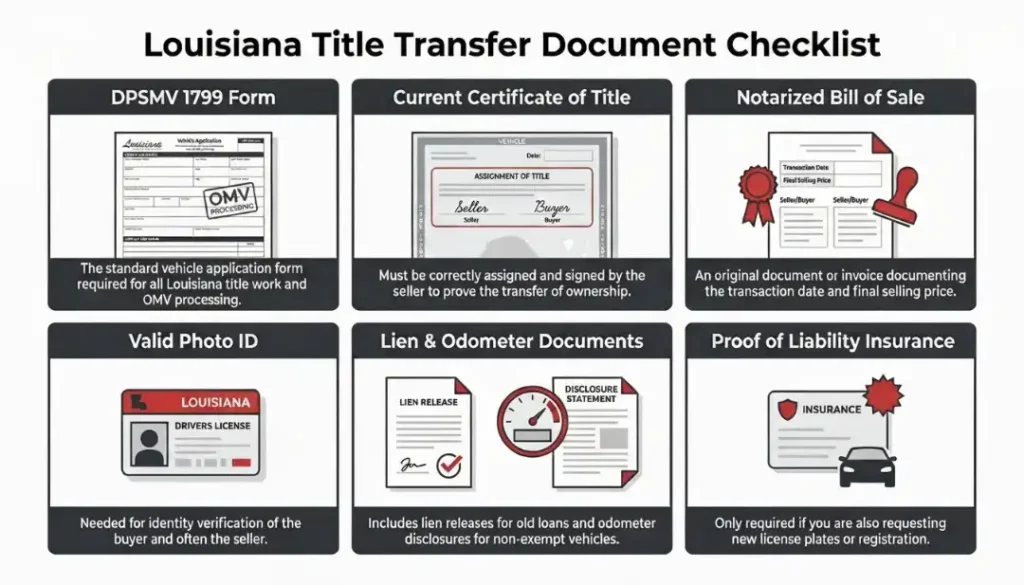
Most standard Louisiana title transfers use the same core set of documents. This is the checklist most buyers and sellers should work from before looking at edge cases.
| Document | Why It Matters | Who Usually Brings It |
| DPSMV 1799 | This is the vehicle application used for title work and related OMV processing. | Usually, the buyer or the office handling the file |
| Current certificate of title | The title proves ownership and must be assigned correctly. | Seller |
| Bill of sale or invoice | Helps document the transaction and selling price. | Buyer and seller |
| Valid photo ID | Needed for identity verification and often for plate issuance. | Buyer and sometimes seller, depending on the scenario |
| Lien release or lien filing documents | Needed if a prior lien must be cleared or a new lien must be recorded. | Seller, lender, or buyer |
| Odometer disclosure if required | Needed when the vehicle is not exempt, and the title does not already contain the disclosure. | Buyer and seller |
| Proof of insurance if plates are issued | Needed when registration and plate work happen with the transfer. | Buyer |
That is the clean version. The details change when the car came from another state, the title was lost, the owner died, or the transaction involves a lender. That is where people burn time by assuming their situation is “probably standard.” It often is not.
What the Seller Should Bring
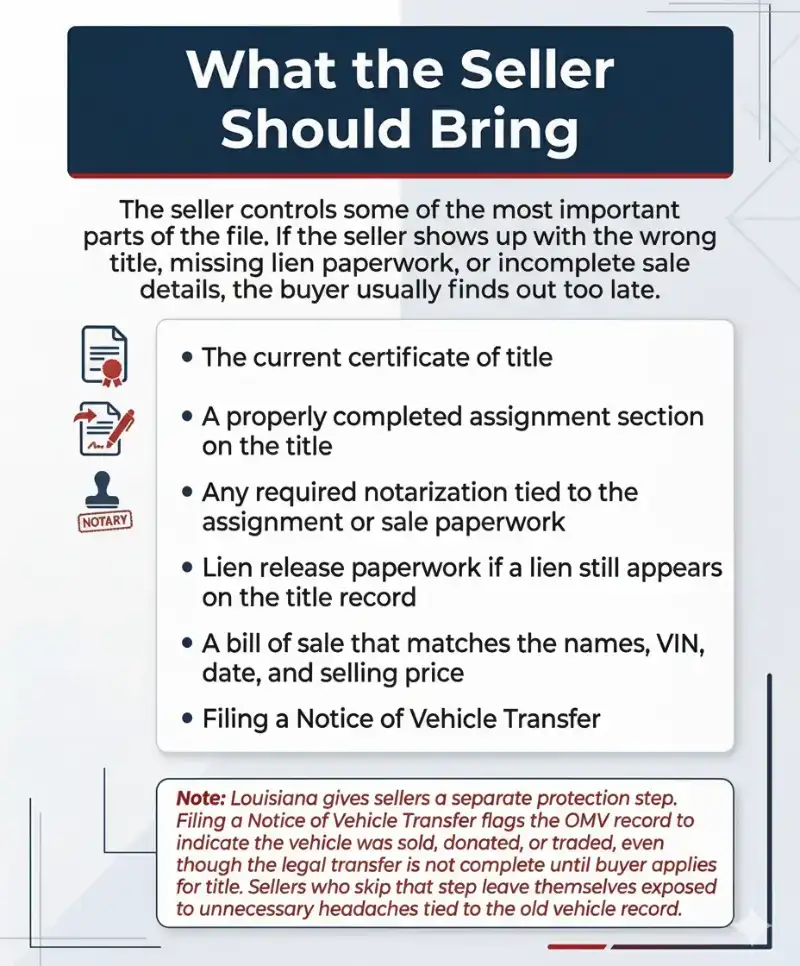
The seller controls some of the most important parts of the file. If the seller shows up with the wrong title, missing lien paperwork, or incomplete sale details, the buyer usually finds out too late.
- The current certificate of title
- A properly completed assignment section on the title
- Any required notarization tied to the assignment or sale paperwork
- Lien release paperwork if a lien still appears on the title record
- A bill of sale that matches the names, VIN, date, and selling price
Louisiana also gives sellers a separate protection step after the sale. Filing a Notice of Vehicle Transfer flags the OMV record to indicate the vehicle was sold, donated, or traded, even though the legal transfer is not complete until the buyer applies for title. Sellers who skip that step leave themselves exposed to unnecessary headaches tied to the old vehicle record.
Once the seller side is clean, the buyer side becomes much easier to organize.
What the Buyer Should Bring
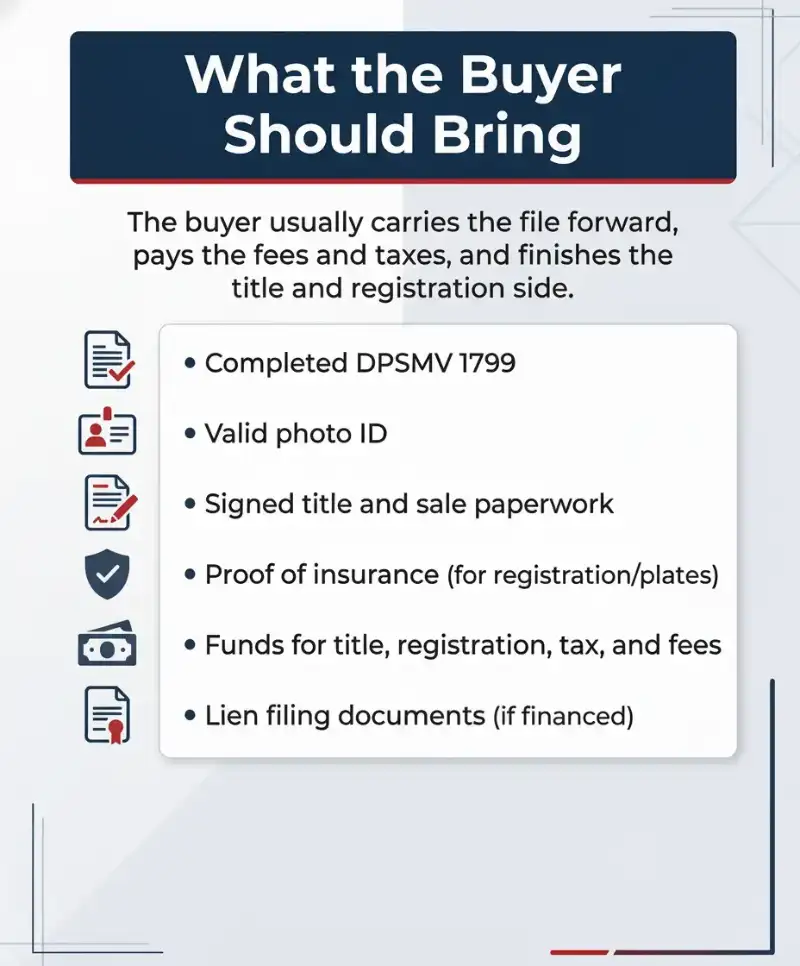
The buyer usually carries the file forward, pays the fees and taxes, and finishes the title and registration side. That means the buyer needs more than just the signed title.
- Completed DPSMV 1799
- Valid photo ID
- Signed title and sale paperwork
- Proof of insurance if registration or plates are being issued
- Funds for title, registration, tax, and related fees
- Lien filing documents if the vehicle is financed
If a lien is being recorded in the new owner’s name, the OMV requires security documentation, such as a UCC-1 or another acceptable lien instrument describing the vehicle. That is one of those details people usually do not know until the file is already sitting on the desk, being annoying.
The next question is the one everyone asks: Do you always need a separate bill of sale?
Do You Always Need a Bill of Sale in Louisiana?
This is where the internet gets sloppy. Some pages make it seem like the answer is always yes. Some act like the title alone does everything. The real answer is more specific.
Louisiana OMV says an original notarized bill of sale or invoice is part of the used title process, but also says a separate bill of sale is not required if the selling price is included on a title with a notarized assignment. That means the facts of the transaction and how the paperwork was completed matter more than broad one-size-fits-all claims.
| Situation | Bill of Sale Impact |
| The title includes the selling price and a notarized assignment | OMV may not require a separate bill of sale |
| Title details are incomplete, or sale terms need support | A bill of sale helps document the transaction clearly |
| Private sale with any confusion or inconsistency | A notarized bill of sale is the safer route |
For practical office use, a clean bill of sale usually helps. It supports the VIN, names, date, and price. It also gives the file less room to shift sideways when something in the title is cramped, unclear, or incorrect.
That leads straight into the next common point of delay: lien paperwork.
When You Need a Lien Release or Lien Filing Documents
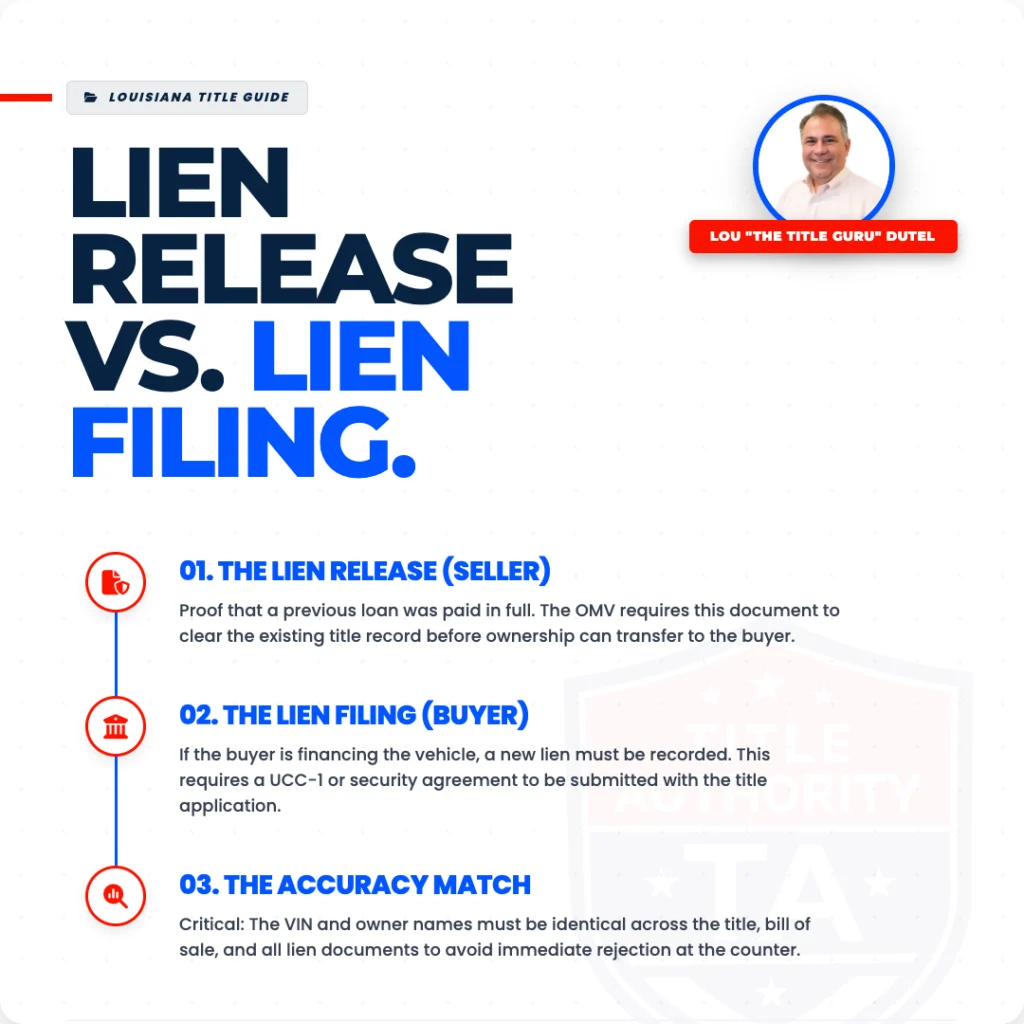
A vehicle with a lien history needs extra attention. If the old lien still appears and has not been released properly, the title transfer can stall. If the buyer financed the vehicle and a new lien needs to be recorded, that paperwork must also be in the file.
- If an old lien exists, bring proof that the lien has been released properly.
- If a new lien will be recorded, bring the lender’s security paperwork.
- Make sure the VIN and owner information match exactly across all lien documents.
OMV guidance points to a UCC 1 or another acceptable security agreement when recording a lien. The key point for readers is simple: if money is still attached to the car, the title file is no longer just a buyer-seller transaction.
Another small detail with a large talent for causing delays is the odometer disclosure rule.
When an Odometer Statement Is Required
Not every vehicle needs separate odometer paperwork. Some are exempt. Some titles already contain the disclosure section. But when the vehicle is not exempt, and the title does not already include the odometer disclosure, OMV requires a supplemental odometer statement.
This is easy to miss because people focus on ownership and signatures rather than mileage disclosure. Then they find out the file is incomplete after they already thought the hard part was done. Check the title carefully before the visit.
Once mileage is handled, the next issue is registration and plates, which adds another layer to the checklist.
What Changes if You Want Plates and Registration at the Same Time
Many buyers are not just transferring title. They also need registration and a plate. That means the file needs more than just title documents.
- Valid photo ID for each owner
- Proof of liability insurance
- Funds for fees, taxes, and plate costs
- Any parish-specific tax impact based on domicile
Louisiana OMV ties plate issuance to ID and insurance requirements. So even if the title paperwork looks fine, the visit can still stall if the buyer shows up without current insurance information.
Special cases make the checklist longer, so they deserve their own breakdown.
What Changes for Special Cases?
Most title problems are not really title problems. They are scenario problems. The paperwork changes because the ownership story changed. Here are the big ones Title Authority customers run into most often.
Not dealing with a standard title transfer?
Lost titles, inherited vehicles, lien issues, and out-of-state paperwork usually need a different path. Title Authority can help you sort the file before you waste time bringing in the wrong documents.
If the Title Is Lost
A missing title changes the path right away. Before the vehicle can usually be sold or transferred cleanly, the owner may need to request a duplicate title. Title Authority’s duplicate title service and FAQ content point people to DPSMV 1799, a valid ID, ownership support, and other related paperwork, depending on the file.
If this is your situation, start with Duplicate Title Requests rather than assuming you can complete the transfer first.
If the Vehicle Came From Out of State
Out-of-state vehicles usually need the out-of-state title, proof of insurance, photo ID, and sale paperwork. Depending on the file, Louisiana may impose tax, inspection, or other state-specific requirements that apply.
Title Authority offers a dedicated Out-of-State Title Transfer service for this exact reason. Interstate paperwork has a way of becoming a time sink when people treat it like a routine local transfer.
If the Vehicle Was Inherited
Inherited vehicle transfers are different because ownership changes hands through death rather than a sale. Title Authority’s FAQ and inherited vehicle service page point to DPSMV 1799, proof of death, a will, or a notarized statement of disposition, and either an Affidavit of Heirship or a Judgment of Possession, depending on how the succession was handled.
If you are dealing with an estate or a family vehicle, go straight to Successions and Inherited Vehicles instead of trying to force the file through a standard sale checklist.
Once you know which scenario applies, the biggest remaining issue is avoiding the mistakes that cause preventable delays.
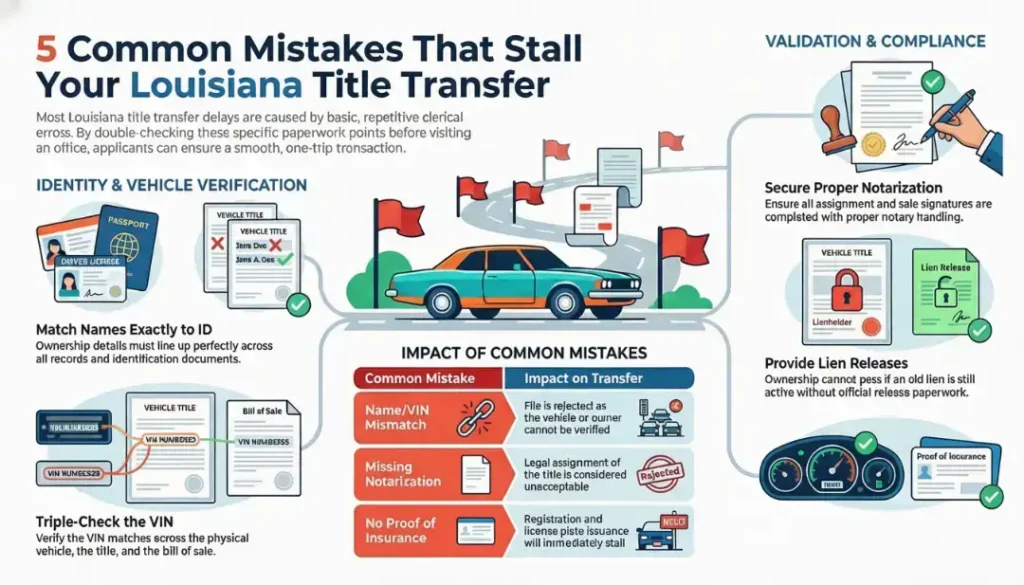
Common Paperwork Mistakes That Slow a Louisiana Title Transfer Down
Most rejected or delayed files are not dramatic. They are basic. That is the frustrating part. These are the mistakes that come up again and again.
| Mistake | Why It Causes Trouble | How to Avoid It |
| Name mismatch | Ownership details do not line up across the file | Match names exactly to ID and title records |
| VIN mismatch | The vehicle cannot be tied cleanly to the transaction | Check the VIN on the vehicle, title, and bill of sale |
| Missing notarization where needed | Assignment or sale paperwork may not be acceptable | Complete signatures with proper notary handling |
| The old lien is still active | Ownership cannot pass cleanly | Bring proper lien release paperwork |
| Missing odometer disclosure | OMV may require supplemental paperwork | Check the title for the odometer section before the visit |
| No proof of insurance for plate work | Registration and plate issuance can stall | Bring current insurance proof |
This is exactly why people use a Public Tag Agent. Not because paperwork is impossible, but because the file is easier to finish when someone reviews it before submission and catches the obvious problems early.

Why Many Northshore Drivers Use a Public Tag Agent Instead of Going Straight to the OMV
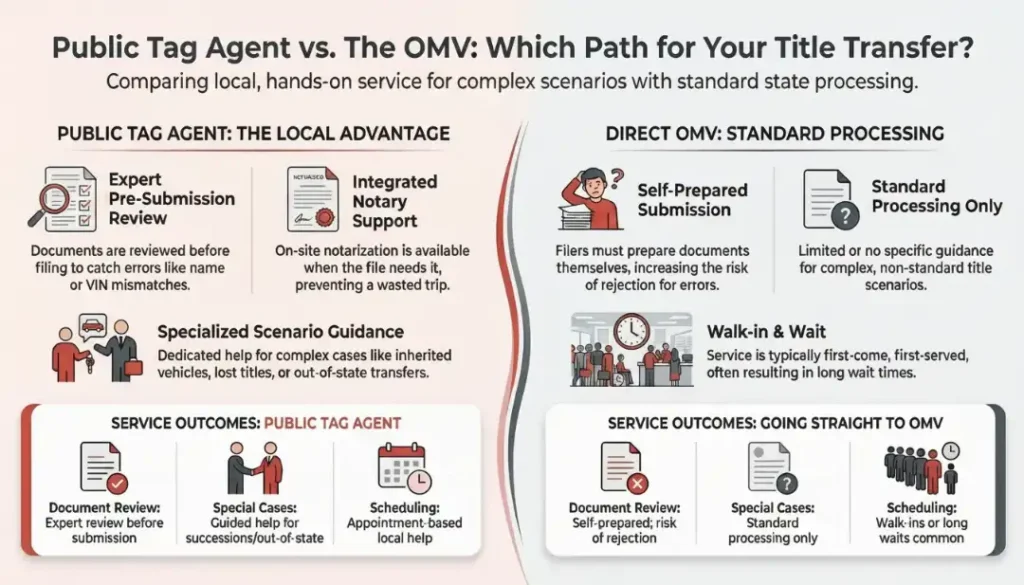
Louisiana OMV allows used title work to be processed through a Public Tag Agent. For many people, that matters less as a legal detail and more as a practical one. They want a local office that can explain the file, review the paperwork, and handle the next step without turning the whole process into an afternoon of lost time.
- One office can review the paperwork before submission
- On-site notarization may be available when the file needs it
- Special cases like inherited vehicles and out-of-state transfers are easier to sort out
- Northshore customers get a local office instead of more guessing
Title Authority’s Covington office is built around that kind of practical help. The site positions the service around title transfers, duplicate titles, inherited vehicle work, notary support, and appointment-based document handling. For a lot of people, that is the difference between getting the file moving and staring at the same problem for another week.
Get Your Louisiana Title Transfer Handled in Covington
If you are preparing for a private sale, trying to register and plate the vehicle, or sorting out a title issue tied to a lien, lost title, or inherited vehicle, bring the right paperwork first. That includes the title, sale paperwork, ID, DPSMV 1799, and any supporting documents your situation calls for.
If you are not sure what applies, do not guess. Use the Documents page, review the FAQs, and then schedule an appointment with the Title Authority in Covington. A short call before the visit can save you from the classic Louisiana paperwork experience, which wastes time because one page was missing the whole time.
Ready to move the transfer forward? Schedule an appointment or call Title Authority in Covington for help with title transfers, duplicate titles, inherited vehicles, and notary-related vehicle paperwork.
Questions People Ask Before a Louisiana Title Transfer
Most people are not trying to become title experts. They want to know what to bring, what can go wrong, and how to get the transfer done without getting bounced around. These are the questions that usually show up right before action.
Do I need DPSMV 1799 for a Louisiana title transfer?
In most title-generating transactions, yes. DPSMV 1799 is the standard vehicle application form used for Louisiana title work. Title Authority also makes that form easy to access on its documents page if you need a starting point.
Do I always need a notarized bill of sale?
Not always as a separate document. OMV says a separate bill of sale may not be required if the selling price is included on the title and the assignment is notarized. In practice, a clean bill of sale still helps support the file and reduce confusion.
What if there is still a lien on the vehicle?
You will usually need proper lien release documentation before ownership can transfer cleanly. If a new lender is to be recorded, lien-filing paperwork may also be required. This is one of the most common points of delay in vehicle title work.
Do I need proof of insurance?
If you are also handling registration or plate issuance, proof of liability insurance matters. Title-only questions and title-plus-plate questions are not always in the same file, so bring current insurance information when in doubt.
What if the title is lost?
You may need to start with a duplicate title request before a normal transfer can move forward. That depends on the exact ownership record and the condition of the file. Title Authority has a dedicated duplicate title service for that scenario.
What extra documents apply to an inherited vehicle?
Inherited vehicle transfers often require DPSMV 1799, proof of death, and either heirship or court succession paperwork. This is not a standard buyer-seller transaction, so the list of documents changes quickly.
Need help with a Louisiana title transfer?
Do not waste a trip over one missing signature or the wrong document. Schedule an appointment with Title Authority in Covington and let our team help you handle your title transfer, duplicate title, inherited vehicle paperwork, or out-of-state transfer with less guesswork and less delay.